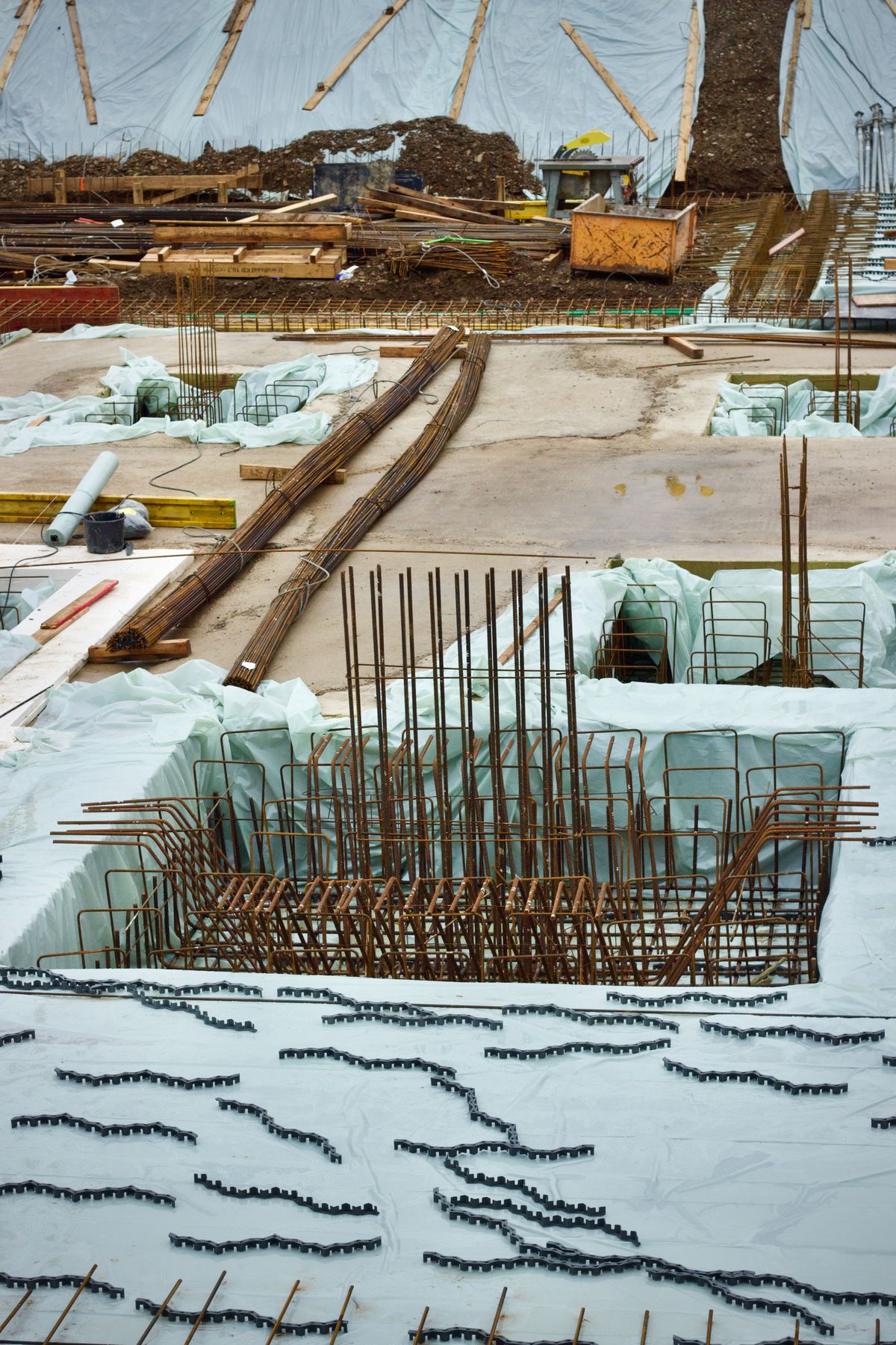
Rebar is the skeleton of reinforced concrete. Without it, concrete has almost no tensile strength. A slab can carry a truck one day and crack under its own weight the next if the reinforcement is wrong. That is why rebar takeoff is one of the most important measurement tasks in construction estimating.
A rebar takeoff is the process of identifying every reinforcing bar in a project, measuring its length, counting how many you need, and calculating the total weight of steel required. The result feeds into your material order, your labor budget, and your bid price. Get it right and you build a structure that stands for decades. Get it wrong and you face expensive rework or a bid that hemorrhages profit.
This guide will teach you how to perform a proper rebar takeoff from construction drawings. You will learn how to read reinforcement details, measure bars correctly, account for laps and bends, calculate weight using standard formulas, and compile everything into a usable report. Whether you are a junior estimator or a seasoned contractor, these methods apply to every reinforced concrete project.
What Is Rebar Takeoff and Why Does It Matter?
Rebar takeoff is the process of measuring and quantifying all reinforcement steel required for a concrete structure. You start with the structural drawings, identify each bar by size and location, measure its length along the bar axis, count the number of identical bars, and then calculate the total weight by bar size.
Accuracy matters because reinforcement quantities affect structural integrity directly. Order too few bars or the wrong size and the concrete element will not have the designed load capacity. Order too much and you waste material that cannot be returned easily since rebar is usually cut and bent to order. Accurate quantities also drive labor estimates. Tying rebar is labor intensive and the number of bars, the complexity of bends, and the density of reinforcement all affect how long your crew needs to complete the work.
Reading Reinforcement Drawings
Before you measure anything, you need to understand how reinforcement is shown on construction drawings. Rebar information lives primarily in three places: the reinforcement (RC) details, the bar bending schedule, and the general arrangement plans. Each bar on an RC detail is labeled with a mark number that corresponds to an entry in the bar bending schedule. A label like "T16-150" means a 16 mm diameter bar at 150 mm spacing. The GA plans show the overall layout with grid lines and dimensions, telling you where each element is located and how many exist.
The Bar Bending Schedule (BBS)
The bar bending schedule is the single most important document for rebar takeoff. It is a table that lists every unique bar in the project with its mark, size, shape, cutting length, number of bars, and total length. A well prepared BBS comes from the structural engineer, but in practice not all projects come with a complete schedule. Many times the contractor has to create one from the drawings.
A standard BBS contains: bar mark (a unique identifier like A1 or B2), bar size (nominal diameter such as 10 mm, 16 mm, 25 mm), shape code (describing the bending pattern per BS 8666 or similar), cutting length (total bar length including bends and laps), number of bars, total length, and total weight. If the project has no BBS, you must create one as part of your takeoff. This is common in smaller projects and it forces you to verify every bar against the drawings, which catches errors early.
Identifying Rebar Sizes and Spacing
Rebar is specified by its nominal diameter. Common sizes range from 10 mm to 40 mm. In metric systems, the bar designation directly indicates the diameter: T16 means a 16 mm bar. In imperial systems, bar sizes use numbers like #4 (1/2 inch), #5 (5/8 inch), and so on up to #18.
Bar spacing is shown in millimeters or inches. A callout reading "T12-200" means 12 mm bars at 200 mm center to center. To count bars for a slab or wall, divide the width of the element by the spacing and add one for the end bar. For a 4 meter slab with T12-200 spacing, that is 4000/200 + 1 = 21 bars. Always check the spacing units. Some older drawings or imported standards use different conventions. When in doubt, measure the spacing on the drawing with a scale to confirm.
Pro Tip
Create a quick reference card with common bar sizes, their diameters, and weight per meter. Tape it to your desk or save it in your takeoff software. You will reference it constantly and it prevents lookup errors.
Measurement Methods: Linear, Counting, and Weight
Rebar quantities are measured in three ways, and you will use all three in a complete takeoff. Linear measurement gives you the cutting length of each bar including hooks and bends. This is what the steel supplier needs to fabricate the reinforcement. It is the most accurate method but also the most time consuming.
Counting works well for standard bars like slab reinforcement mats. You divide the dimension by the spacing and add one. This is especially useful for stirrups and ties in beams and columns, where you know the spacing and the element length. Multiply the count by the cutting length per stirrup to get total linear meters.
Weight calculation is the final step. Rebar is ordered and priced by weight, so your takeoff must output total tonnage. The standard formula for rebar weight per meter is:
Where D is the bar diameter in millimeters. For a 16 mm bar: 16 x 16 / 162 = 1.58 kg/m. For a 25 mm bar: 25 x 25 / 162 = 3.86 kg/m. This formula works for standard steel reinforcement with a density of 7,850 kg/m³. To get total tonnage, multiply the total linear meters for each bar size by its weight per meter, sum across all sizes, and divide by 1,000.
10 mm
0.62 kg/m
500 lm x 0.62 = 310 kg
12 mm
0.89 kg/m
800 lm x 0.89 = 712 kg
16 mm
1.58 kg/m
1,200 lm x 1.58 = 1,896 kg
20 mm
2.47 kg/m
600 lm x 2.47 = 1,482 kg
25 mm
3.86 kg/m
400 lm x 3.86 = 1,544 kg
32 mm
6.32 kg/m
200 lm x 6.32 = 1,264 kg
Lap Splices, Hooks, and Bends
Rebar rarely comes in lengths long enough to cover an entire structure without joints. Lap splices overlap two bars to transfer forces. The lap length is specified in the drawings or general notes, usually as a multiple of the bar diameter. A common value is 40d (40 times the diameter) for tension laps. For a 16 mm bar, that is 640 mm. Missing lap lengths is one of the most common rebar takeoff errors. A lap adds 5% to 10% more steel to a project, so forgetting them significantly understates your total tonnage.
Hooks provide anchorage at bar ends. A standard 180 degree hook adds about 12d to the cutting length. Bends in stirrups and ties also add length. Each 90 degree bend adds approximately 1.5d to 2d depending on the bend radius and the standard used. These small amounts add up when you have hundreds of stirrups. When creating a bar bending schedule, the cutting length already includes these allowances. But if you are measuring directly from the drawings, you need to account for hooks and bends manually using the shape codes from your local standard.
Waste Factors for Rebar
No rebar takeoff is complete without a waste factor. Waste comes from cutting losses, damage during handling, and bars installed incorrectly. For simple projects like ground slabs and footings with straight bars, 3% to 5% waste is typical. For complex projects with many bent bars, beams with heavy shear reinforcement, or curved structures, use 5% to 8%. For specialty work with tight tolerances, some estimators use 8% to 10%.
A good practice is to apply waste factors by bar size. Small bars (10 mm to 16 mm) tend to generate more waste because they are used in higher quantities and are harder to handle without bending. Large bars (25 mm and above) are usually cut more precisely. A graduated waste factor gives a more accurate total than a single blanket percentage.
Compiling a Rebar Takeoff Report
Once you have measured all the bars, accounted for laps and bends, and applied waste factors, compile your findings into a clear report. A well structured rebar takeoff report has three main sections.
First, the bar bending schedule lists every bar mark with its size, shape, cutting length, number of bars, total length, and total weight. This is the document your steel supplier uses to fabricate the reinforcement and your site team uses to verify delivery.
Second, a summary by bar size shows total linear meters and total weight for each size across the entire project. This is what you use for procurement. It tells you how many tons of 10 mm, 12 mm, 16 mm, and so on you need, including the waste factor applied to each size.
Third, the total tonnage is the sum of all bar sizes after waste. This is the number that goes into your cost estimate and your bid. Most suppliers price rebar per metric ton, so this is what you use to get quotes and what your client may ask for when reviewing your bid.
Common Mistakes in Rebar Takeoff
Rebar takeoff is detail intensive and errors are easy to miss. Here are the most common ones and how to avoid them.
Fix: Where two layers of reinforcement cross, such as at beam column joints, the bars from each layer are separate. Mark each element on the drawing as you measure it and use a systematic sequence to avoid going back over the same area.
Fix: Lap lengths are specified in the drawings or general notes. Do not assume a standard lap length. Check the notes for each element because different elements may have different lap requirements based on stress conditions and concrete strength.
Fix: Small reinforcement items like column ties, beam stirrups, and slab chairs are easy to overlook because they are numerous. Create a checklist of all reinforcement types and verify each one against the drawings before finalizing your takeoff.
Fix: Concrete cover affects the length of bent bars. A stirrup in a beam is not just the perimeter minus a fixed amount. Account for the cover on all sides and the bend radius at each corner using the correct shape code formulas from your local standard.
Fix: If a project has multiple pours or phases, separate rebar quantities by pour. Ordering all the steel at once for a phased project means you pay for storage and risk damage. Separate your BBS by pour sequence or floor level.
Fix: Metric and imperial units mixed in the same drawing set are a common source of error. A 20 mm bar is not the same as a #6 bar. Check every dimension and every callout for units before you start measuring.
Final Thoughts on Rebar Takeoff
Rebar takeoff is a skill that improves with practice and a systematic process. The estimators who produce accurate quantities are not necessarily faster at measuring. They follow a methodical workflow, check their work at every stage, and use tools that reduce manual errors.
The difference between a good rebar takeoff and a bad one is usually not in the big measurements. It is in the details: the lap length you forgot, the stirrup you missed, the hook allowance you did not add. Catch those details and your rebar quantities will be accurate, your bids will be competitive, and your projects will have the steel they need to perform as designed.
Recommended Tools
These tools can help improve your educational process, whether you go digital or stick with manual methods.
Rebar Tools and Bending Equipment
Essential tools for cutting, bending, and tying rebar on site. From manual benders to hydraulic cutters, these make reinforcement work faster and safer.
Construction Calculators
Dedicated construction calculators with built-in rebar weight formulas, volume conversions, and material estimation functions for on-the-job use.
Digital Measuring Tools
Digital measuring wheels, laser distance meters, and scale rulers that speed up drawing measurements and reduce reading errors.
Need Accurate Rebar Quantities?
Stop guessing or spending hours on manual rebar takeoffs. Upload your structural drawings to Takeoff Hub and get precise rebar quantities, bar bending schedules, and total tonnage within 48 hours. No software to buy.
Get Started FreeContinue Reading